



Every fleet operator who gets far enough into an electrification business case ends up with the same two documents side by side: a battery purchase quote and a Battery-as-a-Service proposal. One has a large number at the top, and the other has a monthly figure and a contract term.
Before that comparison means anything, ask why storage is on the table at all. Vendors rarely start there because the answer isn’t always a reason to buy their battery specifically. Once you’re clear on what storage has to do for your depot, the purchase-versus-BaaS decision looks different and the gaps in a typical proposal become obvious.
Why does storage enter the conversation in the first place?
BESS are key to depots for one of three reasons: the grid connection can’t support the load a fleet needs, demand charges spike when vehicles plug in together, or a grid upgrade is the alternative, and it isn’t cheap. Grid upgrades typically run $1.2M–$2.0M per site, well before you’ve bought a single charger. Storage is the buffer that lets a depot electrify without waiting on the network operator or paying for that upgrade outright. That’s the case for storage in general. It has nothing to do with whether you buy the battery, lease it, or take it as a service; that’s a financing question, not a needs question. Most vendor proposals collapse the two into one pitch, which is exactly how a fleet operator ends up evaluating a financing structure before they’ve confirmed the underlying need.
A battery on its own doesn’t solve any of this.
Having enough storage is important, but it’s not enough on its own. If a battery just charges and discharges on a set schedule, it won’t always lower demand charges or make sure every vehicle is ready for its shift. Real savings come from a system that actively decides when to charge, hold, or use stored energy instead of the grid, for every vehicle and every shift. The system that manages when to charge and use storage is separate from the battery itself, and it needs to work with any hardware. This means the same control system should work even if your storage and chargers come from different vendors. If a proposal only prices the battery, it’s only showing half the picture, no matter how you pay for it.
Three ways to acquire the storage
After you know you need storage, there are three main ways to get it. Each option comes with its own responsibilities:
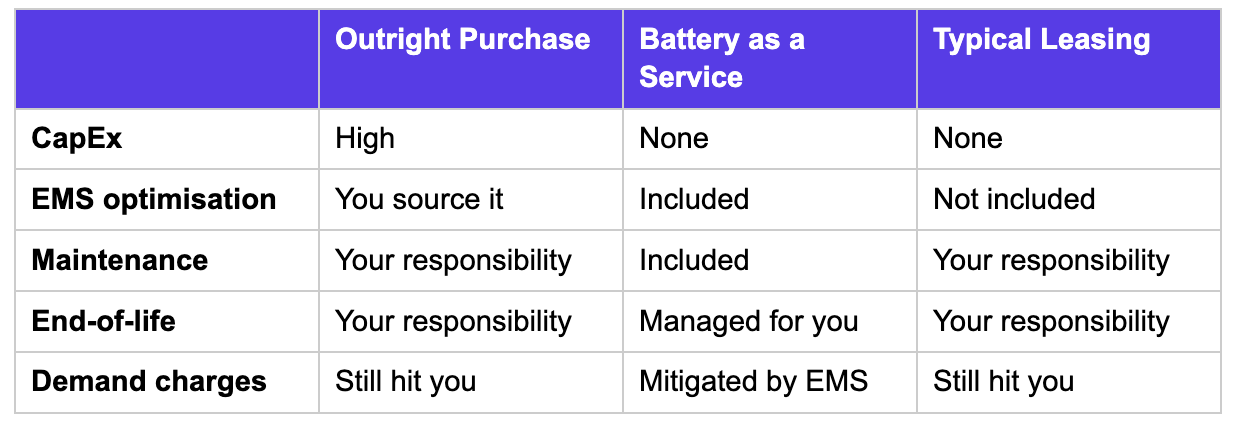
The columns that matter most are those a purchase quote never shows: who carries maintenance, who carries end-of-life, and whether demand charge mitigation is included or still needs to be built.
What proposals typically leave out
We see the same four gaps in almost every comparison that fleet operators bring to us:
- A purchase quote usually covers just the battery, not the software that makes it useful. The EMS (energy management system) is often listed separately or comes from another vendor, and it’s rarely shown up front.
- Maintenance costs often appear only after you sign the contract, not in the main price. Batteries wear out and need service over their 7-year or longer life, and someone has to pay for that.
- Whoever owns the battery is responsible for what happens at the end of its life and for removing it. If you buy the battery, that’s your responsibility, and it’s rarely included in the first-year costs.
- Reducing demand charges doesn’t happen automatically. Without an EMS, a battery only delivers part of the possible savings, which can quietly make the payback period longer than the proposal suggests.
Running the numbers on a 2MWh depot
Do you need to own an asset to fully enjoy its benefits? Or a usership strategy can be better and more flexible.
Indicative market pricing puts the outright purchase of a battery at $600,000–$1,000,000+ per MWh. For a 2MWh system, that’s $1,2M–$2M in hardware alone. Adding an EMS layer at roughly $2,299/month means seven years of orchestration add about $193,000. This brings the fully loaded purchase path to roughly $1.3 M at the low end and about $2.2M at the high end. Neither figure includes maintenance or end-of-life costs, which are real costs but are rarely quoted up front.
A Battery-as-a-Service model priced at roughly $8kWh/ month works out to ≈$16,000/month for 2 MWh, or ≈$1.34M over a 7-year term, but that figure already includes procurement, installation, monitoring, maintenance, EMS optimisation, and end-of-life management.
Line those up and the honest answer is it depends on where your hardware quote lands. At the low end of the purchase range, buying outright and adding EMS separately can be cheaper than BaaS before accounting for maintenance and end-of-life, which you’d still carry yourself. At the high end, BaaS is cheaper even before those costs. That crossover point is the detail a purchase-only quote has no reason to disclose because it only needs to look competitive on the number at the top.
What this means for your decision
This isn’t an argument that BaaS always wins; it doesn’t, and the numbers show why. It’s an argument for insisting that any comparison you get puts four things on the same table: hardware or acquisition cost, EMS/orchestration cost, ongoing maintenance, and end-of-life liability. Whichever way you finance the battery, the orchestration layer determines whether the asset delivers the demand-charge savings your business case depends on.
(For the underlying mechanics of how demand charges are triggered and compound, see our companion article on how demand charges quietly destroy the EV fleet business case. For why the grid upgrade alternative is often avoidable in the first place, see our piece on why grid upgrades aren’t always the answer.)
We’ll walk through your depot’s numbers line by line: hardware, orchestration, maintenance, and end-of-life. This way, you compare what you’re actually being offered, not just the number on page one.